

Spirits Market to Reach USD 650.36 Billion by 2035 at 1.81% CAGR as Premiumization and Craft Innovation Reshape Demand
Spirits Market
Spirits Market is projected to grow from USD 543.57 billion in 2025 to USD 650.36 billion by 2035, driven by premiumization and evolving consumer preferences.
The spirits category is increasingly shaped by premiumization, moderation, innovation, and changing social occasions.”
NEW YORK, NY, UNITED STATES, August 28, 2026 /EINPresswire.com/ -- — Industry Market Analysis
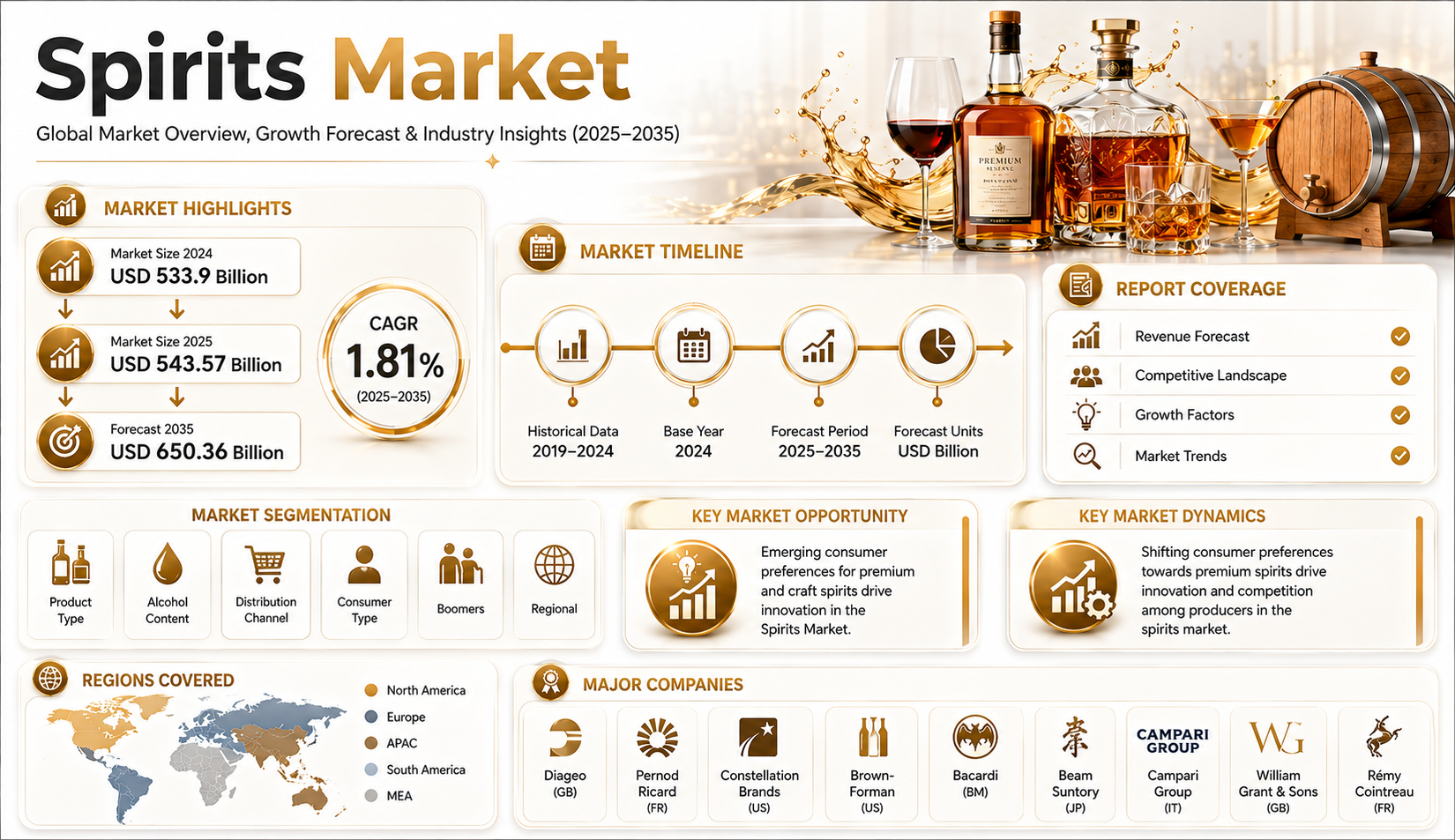
The global Spirits Market is entering a period of gradual but structurally significant expansion as consumers increasingly prioritize quality, provenance, product differentiation, and premium drinking experiences. The market is valued at USD 533.9 billion in 2024 and is projected to reach USD 543.57 billion in 2025, before rising to USD 650.36 billion by 2035, representing a 1.81% CAGR from 2025 to 2035. Growth is being influenced by premium and craft spirits, evolving drinking occasions, product innovation, expanding distribution networks, and changing preferences across mature and emerging economies.
The competitive landscape remains highly consolidated at the global level while becoming increasingly diverse at the brand and craft level. Major companies profiled include Diageo, Pernod Ricard, Constellation Brands, Brown-Forman, Bacardi, Beam Suntory, Campari Group, William Grant & Sons, and Rémy Cointreau. Large producers are strengthening their portfolios through premium extensions, localized products, innovation, acquisitions, and consumer engagement. Diageo, for example, identifies premiumization and moderation as major long-term industry themes, while Pernod Ricard has emphasized portfolio management and premiumization, particularly in high-growth emerging markets.
Free Sample Copy - Access A Complimentary Copy of Our Report to Explore Its Content and Insights
Spirits Market Growth Drivers
One of the strongest structural drivers is premiumization. Consumers in several markets are increasingly willing to pay for spirits that offer differentiated ingredients, distinctive production methods, heritage, limited releases, and stronger brand identity. Premiumization is particularly relevant for whisky, tequila, gin, rum, cognac, and premium vodka. Diageo reported that premium-and-above international spirits increased from 26% of category value to almost 35% over the past decade, highlighting the importance of higher-value products to industry growth.
The expansion of craft spirits is reinforcing this trend. Independent distilleries and specialist producers are introducing small-batch products, regional ingredients, experimental maturation techniques, botanical combinations, and locally inspired expressions. Craft production is also increasingly becoming part of the experience economy, with consumers seeking distillery visits, tastings, cocktail experiences, and education around production and provenance.
At the same time, the industry is adapting to moderation and changing consumption patterns. Consumers are not necessarily abandoning alcoholic beverages; instead, some are becoming more selective about when, what, and how much they drink. The emergence of no- and low-alcohol alternatives, smaller serves, premium mixers, and alternating alcoholic and non-alcoholic beverages is creating new consumption occasions. Diageo has described this behavior as “zebra striping,” reflecting consumers switching between alcoholic and non-alcoholic drinks during social occasions.
Market Segmentation Analysis
By Product Type
The product type segment encompasses major spirit categories such as whisky, vodka, rum, gin, tequila, brandy, cognac, and other distilled beverages. Whisky continues to benefit from premium and aged expressions, single malts, blended innovations, and expanding consumption in emerging economies. Tequila has gained substantial international attention through premium and super-premium variants, while gin has benefited from botanical experimentation and cocktail culture.
Vodka remains relevant because of its versatility in mixed drinks, while rum continues to benefit from both traditional consumption and premium aged expressions. Brandy and cognac occupy a more complex position, with premiumization providing opportunities but economic and regulatory pressures affecting some major markets.
By Alcohol Content
The alcohol content segment differentiates conventional spirits from lower-alcohol and alcohol-free alternatives. Traditional spirits remain the core of market revenues, but moderation is encouraging producers to broaden portfolios.
Non-alcoholic spirits are increasingly being positioned around sophisticated flavor profiles rather than simply as substitutes for alcoholic beverages. Diageo stated that its non-alcoholic portfolio grew significantly and expanded through products such as Tanqueray 0.0, Gordon's 0.0, Seedlip, and Guinness 0.0.
By Distribution Channel
Distribution channels include on-trade and off-trade formats, with digital commerce increasingly influencing consumer discovery and purchasing behavior where regulations permit. Supermarkets, hypermarkets, specialty liquor retailers, convenience stores, and dedicated beverage outlets remain important for packaged spirits.
Bars, restaurants, hotels, clubs, and other hospitality establishments are particularly important because they introduce consumers to premium products through cocktails and curated experiences. E-commerce and digital platforms are strengthening product discovery, comparison, reviews, and direct brand engagement, although regulatory requirements continue to shape online alcohol sales across countries.
By Consumer Type
The consumer type segment reflects differences in purchasing motivations, drinking occasions, income levels, and demographic preferences. Younger legal-age consumers are increasingly interested in authenticity, experimentation, premium cocktails, social experiences, and products with distinctive identities. Meanwhile, established consumers continue to support traditional categories and familiar brands.
The market is therefore becoming less dependent on a single consumption pattern. Casual socializing, celebrations, dining, gifting, nightlife, home entertainment, and cocktail preparation are creating different opportunities for spirits brands.
By Boomers
The Boomers segment remains relevant because this consumer group generally has established brand awareness and experience with traditional spirits categories. Their preferences can support demand for whisky, cognac, brandy, aged rum, and premium expressions.
Producers are increasingly balancing heritage-oriented marketing with contemporary packaging, premium presentation, and accessible product education. This allows established brands to maintain loyalty while introducing new formats and expressions.
Regional Market Analysis
North America
North America represents a mature spirits market characterized by strong brand competition, premiumization, cocktail culture, and increasing interest in moderation. The United States remains particularly important for premium spirits and established international brands. However, recent industry results indicate softer consumer conditions, demonstrating that premiumization does not eliminate sensitivity to economic pressures. Pernod Ricard reported declining U.S. sales in FY2026 amid weaker market conditions.
Europe
Europe has a deeply established spirits ecosystem, supported by whisky, gin, vodka, cognac, rum, and regional specialties. The region benefits from strong heritage and tourism-related consumption but faces regulatory, demographic, and moderation-related challenges. Premium and craft products provide opportunities to generate value despite relatively mature volume growth.
Asia-Pacific
Asia-Pacific is one of the most strategically important regions because of rising disposable incomes, urbanization, expanding middle classes, and growing interest in international and premium spirits. India is particularly significant. Pernod Ricard reported strong underlying demand and continued premiumization in India, with international brands including Jameson showing strong performance.
South America
South America offers opportunities through rising premiumization, expanding modern retail, and growing interest in international spirits and cocktails. Brazil and other major economies remain important markets, although currency movements, taxation, inflation, and economic volatility can influence consumption.
Middle East & Africa
The MEA region presents a more diverse market environment because consumption patterns and regulations vary substantially by country. Tourism, hospitality, premium dining, and high-income consumer segments can create opportunities in markets where alcohol sales are permitted. Meanwhile, regulatory restrictions in several countries limit addressable demand.
Competitive Landscape and Industry Strategy
Competition increasingly revolves around portfolio quality rather than volume alone. Global companies are investing in premium and super-premium categories, strengthening local production, developing RTDs, introducing alcohol-free alternatives, and using experiential marketing to differentiate brands.
Pernod Ricard has demonstrated this approach through portfolio reshaping in India, including the sale of Imperial Blue to Tilaknagar Industries to increase its focus on premiumization and innovation. Diageo has similarly emphasized innovation, consumer data, technology, and premium brands as components of its long-term strategy.
Recent Industry Developments
1. Pernod Ricard launches Xclamat!on in India: In December 2025, Pernod Ricard India introduced Seagram's Xclamat!on, a portfolio covering whisky, vodka, gin, rum, and brandy, designed around India's growing premium and quality-conscious consumer base.
2. Diageo expands Indian craft-spirit infrastructure: In August 2025, Diageo India broke ground on The Good Craft Co. Flavour Market in Goa, combining a craft distillery, innovation lab, startup incubator, retail hub, and experiential center focused on Indian craft spirits.
Future Outlook
The Spirits Market is expected to advance steadily through 2035, although the 1.81% CAGR indicates a relatively moderate growth trajectory. Future value creation is likely to depend more on premiumization, portfolio mix, innovation, and consumer engagement than on rapid volume expansion.
Producers that successfully combine heritage with modern consumption trends are positioned to benefit. Premium whisky, tequila, gin, craft spirits, innovative cocktails, RTDs, and non-alcoholic alternatives can provide differentiated growth avenues. Emerging markets, particularly those experiencing expanding middle-class populations, could become increasingly important to multinational spirits companies.
At the same time, companies will need to navigate taxation, advertising restrictions, responsible-drinking initiatives, economic uncertainty, changing consumer attitudes, and regional regulatory differences. The industry's long-term direction therefore points toward higher-value products, broader consumer occasions, greater product experimentation, and more sophisticated portfolio management.
Frequently Asked Questions
1. What is the projected size of the Spirits Market by 2035?
The Spirits Market is projected to reach USD 650.36 billion by 2035, increasing from USD 543.57 billion in 2025 at a CAGR of 1.81% during 2025–2035.
2. What is driving growth in the Spirits Market?
Key growth factors include premiumization, craft spirits, product innovation, emerging-market demand, evolving social occasions, and increasing consumer interest in differentiated and moderation-oriented products.
Read Our Related Research Report
RTD Spirit Market -
https://www.marketresearchfuture.com/reports/rtd-spirit-market-5502
Luxury Wines and Spirits Market -
https://www.marketresearchfuture.com/reports/luxury-wines-spirits-market-7236
Premium Spirits Market - https://www.marketresearchfuture.com/reports/premium-spirits-market-27493
White Spirits Market -
https://www.marketresearchfuture.com/reports/white-spirits-market-7387
Flavored Spirits Market -
https://www.marketresearchfuture.com/reports/flavored-spirits-market-3574
Sagar Kadam
Market Research Future
+1 628-258-0071
email us here
Legal Disclaimer:
EIN Presswire provides this news content "as is" without warranty of any kind. We do not accept any responsibility or liability for the accuracy, content, images, videos, licenses, completeness, legality, or reliability of the information contained in this article. If you have any complaints or copyright issues related to this article, kindly contact the author above.
