

Honey Marker to Reach USD 17.3 Billion by 2035 Driven by Natural Sweetener Demand, Growing at 5.65% CAGR
Honey Market
Honey is a natural sweetener valued for its unique flavor, nutrition & versatile use in beverages, healthcare & wellness products. Organic demand is growing.
NEW YORK, NY, UNITED STATES, July 15, 2026 /EINPresswire.com/ -- Honey Market OverviewThe global Honey Market Size is experiencing steady transformation as consumers increasingly shift toward natural, minimally processed, and healthier alternatives to artificial sweeteners. Growing awareness regarding the nutritional benefits of honey, rising interest in organic food products, and expanding applications across food, beverages, cosmetics, and healthcare sectors are contributing to the changing dynamics of the industry.
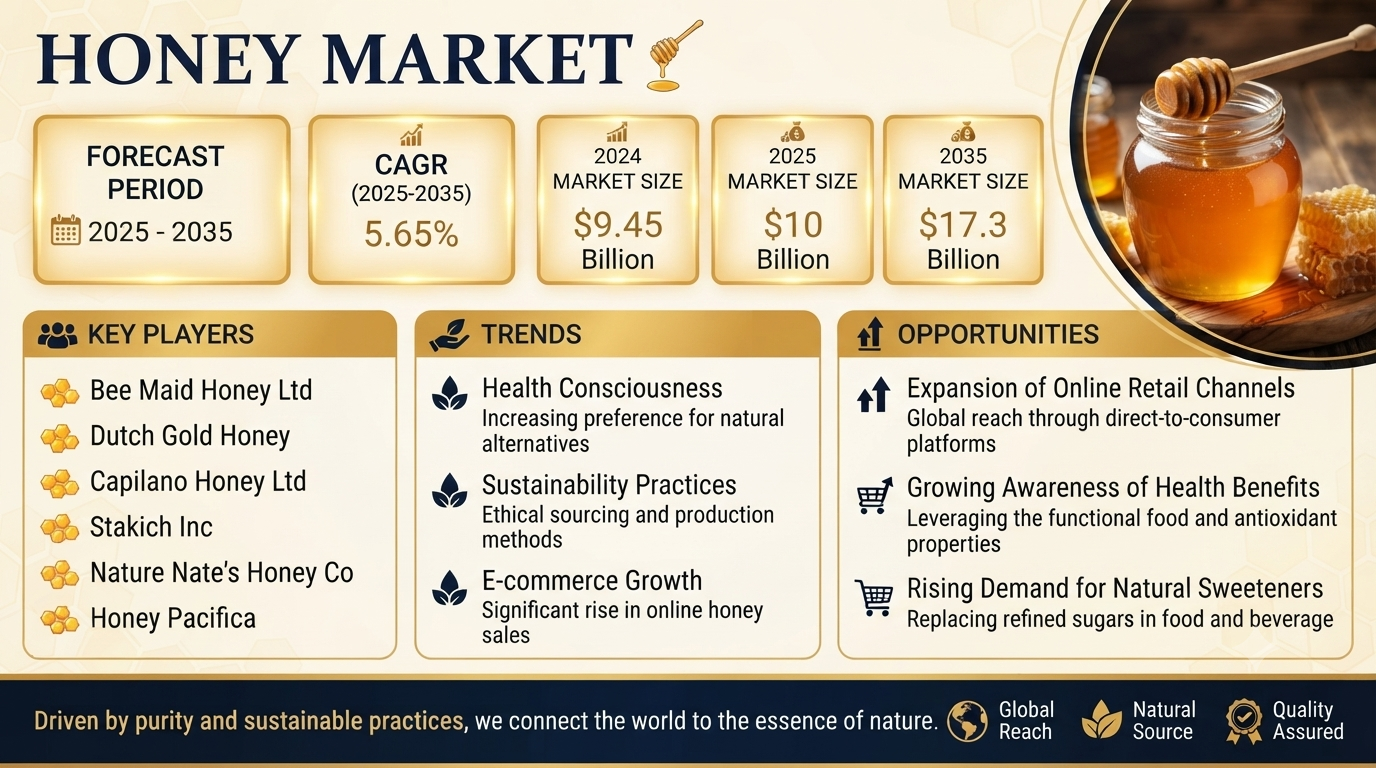
According to Market Research Future analysis, the Honey Market Size was valued at USD 9.45 Billion in 2024. The industry is projected to grow from USD 10.0 Billion in 2025 to USD 17.3 Billion by 2035, registering a compound annual growth rate (CAGR) of 5.65% during the forecast period 2025–2035. The report evaluates major factors influencing industry expansion, including consumer preferences, product innovation, evolving distribution networks, and increasing demand for premium honey varieties.
Honey has maintained its importance as a traditional natural ingredient while gaining new relevance among modern consumers seeking clean-label and functional food options. The increasing replacement of refined sugar with natural sweetening ingredients has encouraged food manufacturers to incorporate honey into bakery products, beverages, nutritional products, and health-focused formulations.
Rising Demand for Natural & Organic Sweeteners Driving Growth:
One of the primary factors supporting the expansion of the honey industry is the increasing demand for healthier alternatives to conventional sweeteners. Consumers worldwide are becoming more aware of the potential concerns associated with excessive consumption of artificial ingredients and highly processed sugars. As a result, honey is gaining recognition as a naturally derived ingredient with versatile applications.
The growing clean-label movement has encouraged food and beverage companies to reformulate products using recognizable and natural ingredients. Honey is being increasingly used in breakfast cereals, energy bars, yogurt products, beverages, sauces, and confectionery items as manufacturers aim to meet changing consumer expectations.
Organic honey has emerged as a particularly attractive category due to rising demand for chemical-free and environmentally responsible food products. Consumers are willing to invest in premium honey products that provide transparency regarding sourcing, processing techniques, and quality standards.
Additionally, honey’s traditional association with wellness and immunity support has contributed to increased household consumption. Many consumers incorporate honey into daily diets through herbal beverages, home remedies, and nutritional preparations, further supporting market growth.
Expanding Uses in Food, Beverage, Healthcare & Personal Care:
The application scope of honey has expanded significantly beyond its traditional role as a household sweetener. Food manufacturers are increasingly exploring honey as a functional ingredient that can enhance flavor profiles while supporting consumer demand for natural formulations.
In the food industry, honey is widely used in bakery products, desserts, sauces, dressings, and snack products. Its ability to provide sweetness, texture improvement, and natural preservation qualities makes it a valuable ingredient for manufacturers developing innovative food solutions.
The beverage sector represents another important area of growth. Honey-based drinks, flavored beverages, herbal teas, and wellness-focused products are gaining popularity as consumers look for alternatives to artificially sweetened beverages. The combination of taste appeal and perceived health benefits is encouraging beverage brands to introduce honey-infused product lines.
The healthcare and personal care industries are also contributing to increased demand. Honey has long been recognized for its traditional applications in wellness products, skincare formulations, and natural cosmetic products. Growing consumer interest in botanical and plant-based ingredients is encouraging manufacturers to integrate honey into creams, masks, lip care products, and other personal care solutions.
Innovation & Premium Product Development Driving New Opportunities:
Innovation remains a significant factor shaping the future direction of the honey industry. Companies are focusing on developing differentiated products to attract consumers looking for unique flavors, enhanced quality, and specialized benefits.
Premium honey varieties, including organic honey, raw honey, and specialty floral honey, are gaining attention among consumers seeking authentic and high-quality products. Regional varieties sourced from specific flowers or geographic locations are increasingly positioned as premium offerings due to their unique taste characteristics and origin stories.
Product packaging and branding strategies are also evolving. Companies are investing in convenient packaging formats, sustainable materials, and informative labeling to improve consumer engagement. Transparent information about sourcing, processing, and certification helps brands establish trust in competitive markets.
Technological advancements in beekeeping and honey processing are further supporting industry development. Improved hive management techniques, quality testing methods, and supply chain monitoring systems are helping producers maintain consistency and improve product quality.
Download Free Sample PDF Copy : – Access A Complimentary Copy of Our Report to Explore Its Content and Insights
https://www.marketresearchfuture.com/sample_request/5139
Impact of Organic Honey Demand on Industry Competition:
The increasing preference for organic honey is influencing competition among producers and suppliers worldwide. As consumers become more conscious about agricultural practices and environmental sustainability, companies are focusing on responsible sourcing and organic certification to strengthen their market position.
Organic honey production requires careful management of beekeeping practices, including maintaining healthy bee colonies, avoiding harmful chemicals, and ensuring sustainable harvesting methods. These requirements have encouraged companies to develop stronger relationships with beekeepers and invest in ethical supply networks.
The rising demand for premium honey products has also influenced pricing strategies across the industry. While conventional honey products continue to serve price-sensitive consumers, premium organic and specialty varieties are creating opportunities for higher-value product categories.
Leading companies are differentiating themselves through product quality, brand reputation, innovation, and sustainability initiatives. The competitive environment is expected to continue evolving as businesses focus on meeting changing consumer expectations.
Honey Market Segmentation Overview:
By Type
The honey industry is segmented into natural, organic, processed, and specialty honey based on source, processing, and quality. Natural honey holds a strong position, while organic and premium varieties are gaining popularity due to rising demand for sustainable and high-quality products.
▪️By Application
Honey is widely used in food & beverages, healthcare, personal care, and household applications. The food and beverage segment leads due to increasing use in bakery, confectionery, beverages, and natural food products. Healthcare applications are also expanding with growing interest in natural wellness ingredients.
▪️By Distribution Channel
Honey products are available through supermarkets, specialty stores, online platforms, and direct sales channels. While retail remains important, e-commerce is growing rapidly by helping premium brands and small producers reach wider consumers.
▪️By Form
Honey products are available in liquid and specialty formats. Liquid honey remains the dominant form due to its convenience and wide use in food, beverages, and household applications. Specialty varieties such as creamed, infused, and blended honey are gaining popularity as consumers seek premium and innovative options. Convenient packaging formats like squeeze bottles and single-use packs are further supporting adoption.
Regional Analysis of the Honey Market:
North America and Europe are key regions in the honey industry, driven by increasing consumer preference for natural sweeteners, organic ingredients, and sustainable food products. In North America, demand for premium, specialty, and organic honey is rising due to greater awareness of clean-label products and transparent sourcing. Europe is witnessing growth through strong interest in ethical production, bee conservation, and traditional honey varieties used in food, beverages, and wellness products.
Asia-Pacific is emerging as a high-potential region with rising disposable incomes, changing dietary habits, and growing awareness of natural health products. Countries such as China, India, Japan, and Australia are experiencing increased honey consumption across household and commercial applications. South America and the Middle East & Africa are also expanding due to favorable beekeeping conditions, cultural significance of honey, and rising demand for natural ingredients. Improving retail networks and e-commerce platforms are further enhancing product availability across these regions.
Key Challenges Affecting Honey Market Development:
Although the honey industry continues to grow, several challenges influence production and market expansion. Climate change remains a major concern because changing weather patterns can affect flowering cycles, bee populations, and overall honey production.
The decline in bee populations in certain regions has created concerns regarding long-term supply stability. Bees play an essential role in ecosystems and agriculture, making conservation efforts increasingly important for industry sustainability.
Another challenge is the presence of counterfeit or adulterated honey products. Maintaining product authenticity and quality assurance is critical for protecting consumer confidence. Companies are increasingly adopting advanced testing technologies and certification systems to verify honey quality.
Price fluctuations associated with production costs, transportation expenses, and supply availability can also influence market competitiveness. Producers must balance maintaining quality standards with offering products that remain accessible to consumers.
Competitive Landscape of the Honey Market:
The global honey industry features a mix of established manufacturers, regional producers, and specialty brands competing through quality enhancement, product innovation, sustainable practices, and broader distribution networks. Companies are increasingly focusing on responsible sourcing, strengthening partnerships with beekeepers, and improving supply chain visibility to address changing consumer preferences.
Key players operating in the Honey Market include:
▪️Bee Maid Honey Ltd (Canada)
▪️Dutch Gold Honey (United States)
▪️Capilano Honey Ltd (Australia)
▪️Stakich Inc (United States)
▪️Nature Nate's Honey Co (United States)
▪️Honey Pacifica (United States)
▪️Wedderspoon (Canada)
▪️Manuka Health (New Zealand)
▪️Savannah Bee Company (United States)
Market participants are investing in premium product development, sustainable honey sourcing, brand expansion, and digital retail strategies to strengthen their market presence. Growing consumer interest in organic, specialty, and traceable honey products is encouraging companies to differentiate their offerings through innovation and enhanced product experiences.
Future Outlook of the Honey Market:
The future of the honey industry is expected to remain positive, supported by rising demand for natural sweeteners, sustainable food products, and clean-label ingredients. Growing consumer preference for healthier alternatives to artificial sweeteners will continue driving adoption across food, beverage, and wellness applications.
Innovation, premium product development, and sustainable sourcing will shape the industry’s future growth. Companies are focusing on new flavors, specialty honey varieties, convenient packaging, and transparent supply chains to meet evolving consumer expectations. The expansion of e-commerce and increasing interest in organic lifestyles are expected to create new opportunities for honey producers worldwide.
Frequently Asked Questions (FAQs)?
1. What factors are driving the growth of the Honey Market?
The growth of the Honey Market is primarily supported by increasing consumer preference for natural sweeteners, rising demand for organic food products, expanding applications in food and beverages, and growing awareness about wellness-oriented ingredients.
2. What is the projected size of the Honey Market by 2035?
According to Market Research Future analysis, the Honey Market is expected to reach USD 17.3 Billion by 2035, expanding from USD 10.0 Billion in 2025 with a CAGR of 5.65% during the forecast period.
3. Which honey products are gaining popularity among consumers?
Organic honey, raw honey, specialty floral honey, and infused honey varieties are gaining popularity as consumers increasingly seek premium products with natural origins and unique benefits.
4. What challenges impact the global honey industry?
Major challenges include climate-related impacts on bee populations, concerns regarding honey authenticity, fluctuating production costs, and the need for sustainable beekeeping practices.
Read Our Related Research Report:
Dried Honey Market:
https://www.marketresearchfuture.com/reports/dried-honey-market-30325
Aramid Honeycomb Market:
https://www.marketresearchfuture.com/reports/aramid-honeycomb-market-25978
Fats and Oil Market:
https://www.marketresearchfuture.com/reports/fats-and-oil-market-68196
Sagar Kadam
Market Research Future
+1 628-258-0071
email us here
Legal Disclaimer:
EIN Presswire provides this news content "as is" without warranty of any kind. We do not accept any responsibility or liability for the accuracy, content, images, videos, licenses, completeness, legality, or reliability of the information contained in this article. If you have any complaints or copyright issues related to this article, kindly contact the author above.
