

Global Blockchain Food Traceability Market to Reach USD 69.22B by 2036, Asia Pacific Dominance | IBM Food Trust, Dock
Blockchain Food Traceability Industry Analysis
Blockchain food traceability adoption accelerates globally driven by regulations, supply chain transparency needs, & rising demand for verified food origin data
NEWARK, DE, UNITED STATES, April 3, 2026 /EINPresswire.com/ -- Future Market Insights (FMI) projects that the blockchain food traceability market is entering an accelerated expansion phase as regulatory enforcement and enterprise demand for transparent food supply chains intensify globally. Increasing pressure on food producers, processors, and retailers to ensure compliance with traceability mandates and provide verifiable origin data is driving large-scale deployment of blockchain-enabled tracking systems across the food ecosystem.
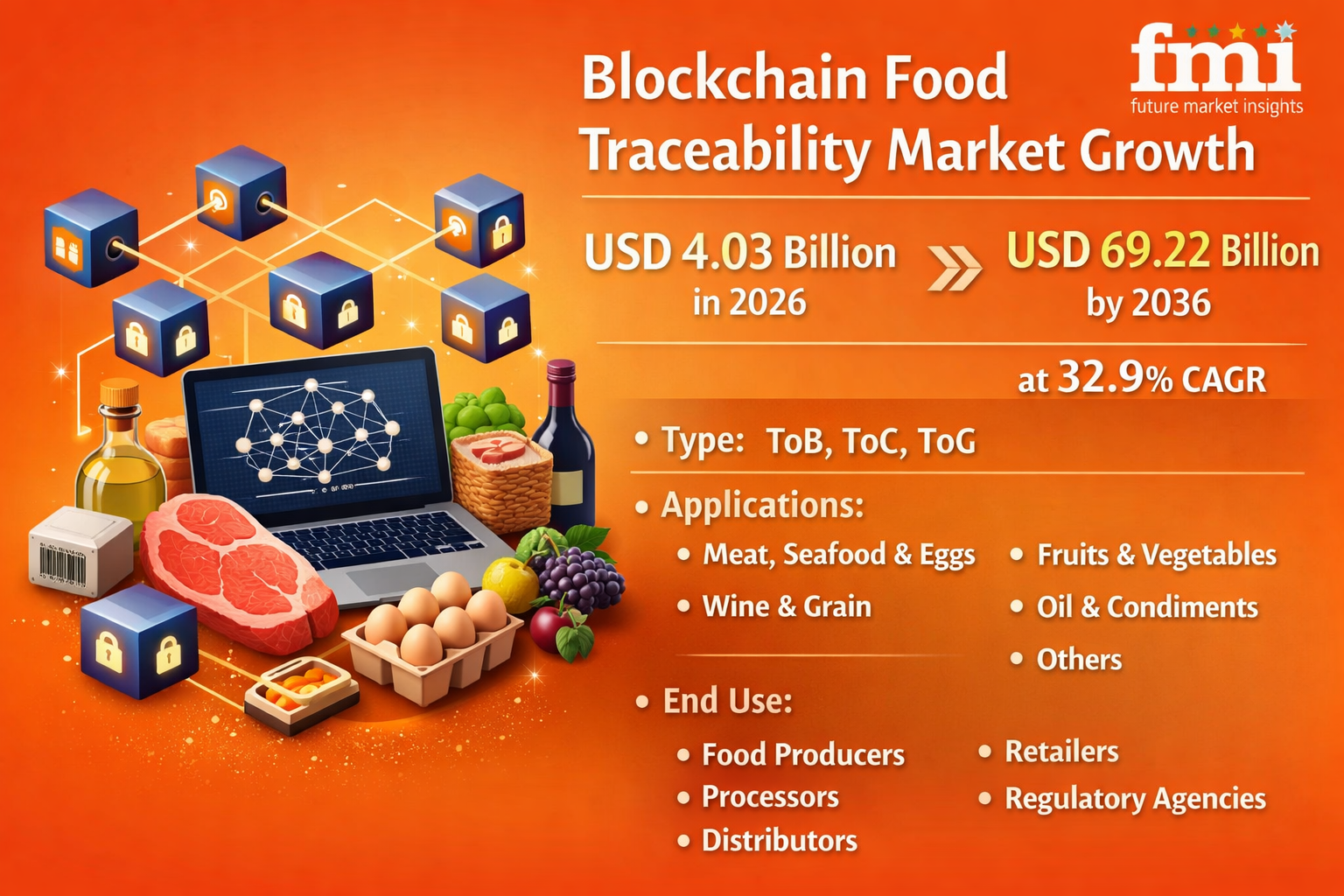
In 2025, the blockchain food traceability market was valued at USD 3.03 billion. According to FMI, demand is expected to reach USD 4.03 billion in 2026 and further surge to USD 69.22 billion by 2036, expanding at a CAGR of 32.9% during the forecast period.
The projected growth reflects a structural shift from pilot-based blockchain adoption to contractually mandated traceability systems, enabling immutable record-keeping, real-time compliance monitoring, and enhanced consumer trust in food safety.
Request Your Sample Now - Unlock Growth Potential and Discover Key Market Opportunities!
https://www.futuremarketinsights.com/reports/sample/rep-gb-27261
Blockchain Food Traceability Market Snapshot
• Market Value (2025): USD 3.03 Billion
• Forecast Value (2036): USD 69.22 Billion
• Forecast CAGR (2026–2036): 32.9%
• Leading Type Segment: ToB (Enterprise) – 62% share
• Top Application: Meat, Seafood & Eggs – 38.2% share
Regulatory Compliance and Transparency Driving Market Expansion
A primary factor accelerating market growth is the enforcement of stringent food safety regulations across global markets. Frameworks such as the EU Farm to Fork Strategy, the U.S. FDA Food Safety Modernization Act (FSMA) Rule 204, and China’s Food Safety Law are mandating end-to-end traceability across food supply chains.
Retailers are increasingly requiring blockchain-verified documentation from suppliers, pushing compliance obligations upstream and driving widespread adoption of distributed ledger technologies. These systems enable real-time tracking, automated audit trails, and improved recall management, significantly enhancing supply chain accountability.
At the same time, rising consumer demand for verified provenance—particularly in high-risk categories such as meat, seafood, and organic produce—is supporting premium pricing for blockchain-traced food products.
Enterprise (ToB) and Protein Applications Lead Demand
By type, enterprise (ToB) blockchain systems dominate the market with a 62% share, driven by strong demand from food processors, distributors, and retailers seeking scalable, compliance-ready traceability solutions.
From an application standpoint, meat, seafood, and eggs account for 38.2% of market demand, as these categories require stringent safety monitoring, contamination tracking, and export compliance verification.
Blockchain traceability solutions are widely deployed across:
• Food production and processing facilities
• Supply chain logistics and distribution networks
• Retail verification and consumer-facing transparency platforms
The segment’s growth is reinforced by increasing global trade complexity and the need for standardized traceability systems across multi-tier supply chains.
IoT Integration and Data Interoperability Enhance Functional Efficiency
Blockchain platforms are increasingly integrated with IoT sensors and real-time monitoring systems to enable automated data capture across supply chain checkpoints. This enhances traceability accuracy while reducing manual intervention and operational risks.
Key functional advantages include:
• Real-time environmental monitoring (temperature, humidity)
• Automated compliance reporting and audit trail generation
• Integration with ERP and supply chain management systems
However, interoperability challenges across different blockchain platforms and high implementation costs—especially for small-scale producers—remain key barriers to widespread adoption.
High-Growth Markets Led by China and India
Geographically, the blockchain food traceability market demonstrates strong growth across both emerging and developed economies. Key country-level CAGR projections include:
• China: 44.4%
• India: 41.1%
• Germany: 37.8%
• Brazil: 34.5%
• USA: 31.3%
• UK: 28.0%
• Japan: 24.7%
China leads global growth due to aggressive government-backed digital agriculture initiatives and mandatory food safety digitization programs. India follows closely, driven by agricultural modernization efforts and increasing adoption of blockchain for export compliance.
Developed markets such as the United States and Germany continue to anchor high-value deployments, supported by advanced supply chain infrastructure and regulatory enforcement.
Competitive Landscape Focused on Platform Ecosystems and Integration
The blockchain food traceability market is highly competitive, with key players focusing on platform scalability, interoperability, and enterprise integration capabilities.
Key companies operating in the market include:
• IBM Food Trust
• VeChain
• Dock
• ANTCHaiN
• TE-FOOD
• Tracefood
• TraceX Technologies
Market competition is increasingly centered on ecosystem development, including IoT integration, analytics dashboards, and API-based connectivity, rather than standalone blockchain infrastructure.
Companies are investing in multi-chain architectures, smart contract automation, and AI-driven analytics to strengthen their value proposition and maintain competitive differentiation.
Market Outlook: Compliance-Driven Adoption to Accelerate Growth
The future outlook for the blockchain food traceability market remains highly robust as regulatory mandates, supply chain digitization, and consumer transparency expectations continue to intensify.
Manufacturers and technology providers are increasingly focusing on:
• End-to-end supply chain integration
• Real-time compliance monitoring systems
• Scalable and interoperable blockchain architectures
• Integration of AI and predictive analytics
• IoT-enabled traceability ecosystems
As the industry transitions from voluntary adoption to mandatory compliance frameworks, blockchain traceability is expected to become a foundational component of global food safety infrastructure.
With increasing emphasis on transparency, safety, and trust, blockchain technology is set to redefine food supply chain operations, driving exponential market expansion through 2036.
Browse More Reports from Food and Beverages:
Shrimp Market: https://www.futuremarketinsights.com/reports/shrimp-market
Demand for Frozen Egg in South Korea https://www.futuremarketinsights.com/reports/south-korea-frozen-egg-market
Vanilla Bean Market: https://www.futuremarketinsights.com/reports/vanilla-bean-market
Resveratrol Market: https://www.futuremarketinsights.com/reports/resveratrol-market
Sudip Saha
Future Market Insights Inc.
+1 347-918-3531
email us here
Legal Disclaimer:
EIN Presswire provides this news content "as is" without warranty of any kind. We do not accept any responsibility or liability for the accuracy, content, images, videos, licenses, completeness, legality, or reliability of the information contained in this article. If you have any complaints or copyright issues related to this article, kindly contact the author above.
