

Natural Food Colors Market to Reach USD 4.4 Billion by 2036 Amid Clean-Label Reformulation Growth
Natural Food Colors
Natural Food Colors Market Growth is driven by regulatory scrutiny, reformulation demand, and rising need for performance-ready ingredient systems
DELAWARE, NY, UNITED STATES, March 26, 2026 /EINPresswire.com/ -- The global natural food colors market is entering a decisive growth phase as food and beverage manufacturers intensify efforts to align product formulations with clean-label expectations while maintaining visual consistency and processing performance. What was once a niche substitution trend is now evolving into a core formulation strategy across packaged foods, beverages, and dairy applications.
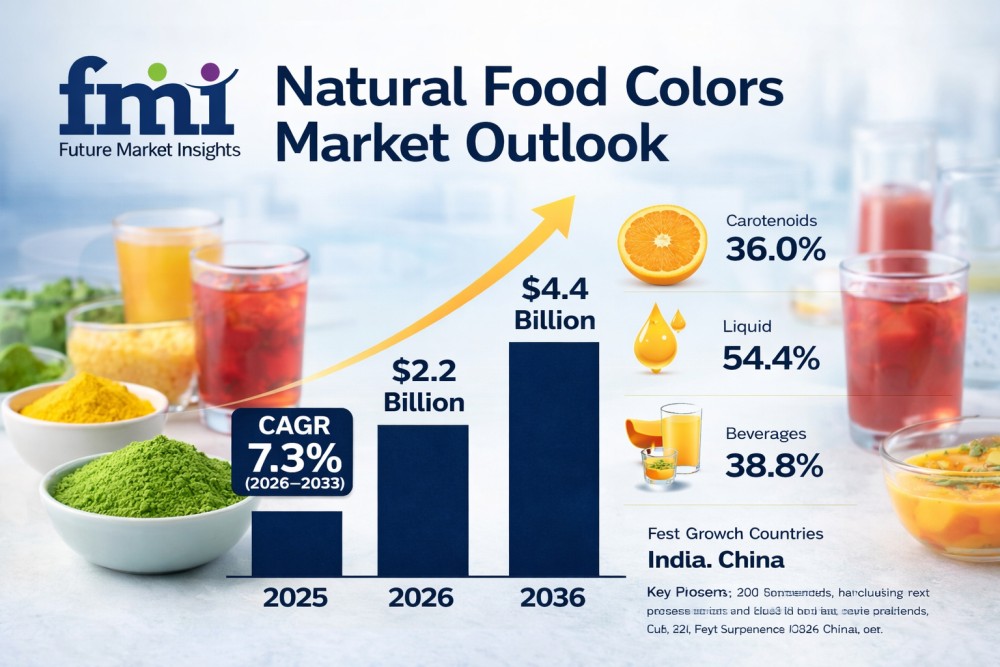
According to a comprehensive strategic outlook released by Future Market Insights, the global Natural Food Colors Market is projected to grow from USD 2.1 Billion in 2025 to USD 4.4 Billion by 2036, reflecting a CAGR of 7.3%. The market is expected to unlock sustained growth opportunities as regulatory frameworks tighten and ingredient transparency becomes central to brand positioning.
Get Access to the Full Report Sample: Explore detailed forecasts, segment insights, and competitive analysis: https://www.futuremarketinsights.com/reports/sample/rep-gb-35
The Evolution of Natural Colors from Label Claim to Functional Necessity
Natural food colors have transitioned from being a marketing-driven inclusion to a performance-critical component in food design. Manufacturers are no longer adopting natural colors solely for consumer perception—they are selecting systems that can withstand processing conditions such as heat, light exposure, and pH variation.
The category includes carotenoids, anthocyanins, curcumin, chlorophyll derivatives, spirulina extracts, and other plant-based pigments. Among these, carotenoids are expected to lead with a 36.0% market share in 2026, supported by their commercial reliability across beverage and dairy applications.
Supply Chain Dynamics Reshaping Pricing and Adoption
Unlike synthetic alternatives, natural food colors depend heavily on agricultural and biological inputs such as beet, paprika, carrot extracts, and algae-derived spirulina. This introduces variability across:
Crop yields and climate conditions
Postharvest handling and storage quality
Extraction efficiency and processing stability
Insights from Food and Agriculture Organization and United States Department of Agriculture highlight how raw material quality and controlled cultivation directly influence output consistency and functional performance.
As a result, supply constraints are emerging as a structural factor—supporting price realization while simultaneously limiting rapid mass-market penetration.
Formulation Reality: Why Liquid Formats Dominate
From an operational standpoint, liquid formats are projected to account for 54.4% of market revenue in 2026, reflecting how modern food manufacturing systems function.
Liquid systems offer:
Precise dosing in high-volume production
Superior dispersion in beverages and dairy
Reduced formulation complexity in industrial workflows
While powder and paste formats retain niche importance, especially in bakery and confectionery, liquids remain the preferred choice where consistency and scalability matter most.
Beverages Anchor Market Demand
Beverages represent the largest application segment, accounting for 38.8% of total demand in 2026. This dominance is driven by:
High production volumes
Strong need for color stability and clarity
Continuous product innovation in flavored and functional drinks
Beyond beverages, dairy, confectionery, and prepared foods contribute significantly, especially where visual appeal directly influences consumer perception and purchase decisions.
Retail and Regulatory Forces Driving Adoption
The push toward natural food colors is closely linked to evolving regulatory frameworks and retailer standards, particularly in North America and Europe. Ingredient labeling requirements and additive restrictions are compelling manufacturers to reassess synthetic color usage.
At the same time, the expansion of packaged food ecosystems is reinforcing demand for standardized, scalable, and compliant color systems. As production volumes rise globally, the need for reliable ingredient solutions becomes increasingly critical.
Regional Dynamics: A Two-Speed Market Structure
The global natural food colors market is developing along a dual-growth trajectory:
Europe remains the largest market, supported by a mature food-processing industry, stringent regulatory oversight, and advanced clean-label adoption.
South Asia Pacific is projected to be the fastest-growing region through 2036, driven by rapid expansion in packaged food manufacturing and rising urban consumption.
This creates a two-speed market dynamic, where developed regions anchor value and formulation depth, while emerging markets expand the long-term opportunity base.
Key Market Insights for Decision Makers
Steady Growth Trajectory: Market projected to expand at a CAGR of 7.3% through 2036
Source Leadership: Carotenoids lead with a 36.0% share due to commercial reliability
Form Dominance: Liquid formats account for 54.4% of revenue driven by industrial usability
Application Focus: Beverages remain the largest segment with 38.8% share
Regional Opportunity: Europe leads in scale, while South Asia Pacific drives fastest growth
The Competitive Edge: Performance Over Portfolio
The competitive landscape is increasingly defined by technical capability rather than product breadth. Leading players are focusing on:
Application-specific solutions
Stability under processing stress
Regulatory compliance across regions
Integrated supply chains from sourcing to formulation
Key companies operating in the market include:
Givaudan
Sensient Technologies Corporation
Oterra
dsm-firmenich
Archer Daniels Midland
Kalsec Inc.
Döhler
ROHA
These companies are investing in co-development partnerships, advanced extraction technologies, and application support capabilities to strengthen their market positioning.
Why the Market is Strategically Important Now
Food and beverage manufacturers rarely change color systems for aesthetics alone. The shift toward natural colors is occurring where:
Regulatory pressure increases
Retailer standards tighten
Consumers demand transparency
Technical feasibility has improved
This convergence creates a structural growth tailwind—but adoption remains selective and performance-dependent.
Why FMI: https://www.futuremarketinsights.com/why-fmi
Frequently Asked Questions (FAQs)
How large is the natural food colors market in 2025?
The market is valued at USD 2.1 billion in 2025.
What will the market size be by 2036?
It is projected to reach USD 4.4 billion by 2036.
What is the expected growth rate?
The market is forecast to grow at a CAGR of 7.3% from 2026 to 2036.
Which source type leads the market?
Carotenoids lead with a 36.0% share in 2026.
Which form dominates the market?
Liquid formats dominate with a 54.4% share.
Which application segment is the largest?
Beverages lead with a 38.8% share in 2026.
Which region is the largest market?
Europe holds the largest market share.
Which region is growing the fastest?
South Asia Pacific is expected to record the fastest growth through 2036.
Have a Look at Related Research Reports on Food & Beverage Domain:
Olive Protein Isolate for Plant-Based Dairy Market: https://www.futuremarketinsights.com/reports/olive-protein-isolate-for-plant-based-dairy-market
Low-Permeation Fuel Lines & Hoses Market:https://www.futuremarketinsights.com/reports/low-permeation-fuel-lines-hoses-market
Peanut Butter Market: https://www.futuremarketinsights.com/reports/peanut-butter-market
Food Certification Market: https://www.futuremarketinsights.com/reports/food-certification-market
Better for You Snacks Market : https://www.futuremarketinsights.com/reports/better-for-you-snacks-market
About Future Market Insights (FMI)
Future Market Insights, Inc. (ESOMAR certified, recipient of the Stevie Award, and a member of the Greater New York Chamber of Commerce) offers profound insights into the driving factors that are boosting demand in the market. FMI stands as the leading global provider of market intelligence, advisory services, consulting, and events for the Packaging, Food and Beverage, Consumer Technology, Healthcare, Industrial, and Chemicals markets. With a vast team of over 400 analysts worldwide, FMI provides global, regional, and local expertise on diverse domains and industry trends across more than 110 countries.
For Press & Corporate Inquiries
Rahul Singh
AVP - Marketing and Growth Strategy
Future Market Insights, Inc.
📞 +91 8600020075
📞 +1-347-918-3531
📧 sales@futuremarketinsights.com
🌐 www.futuremarketinsights.com
Sudip Saha
Future Market Insights Inc.
347-918-3531
email us here
Legal Disclaimer:
EIN Presswire provides this news content "as is" without warranty of any kind. We do not accept any responsibility or liability for the accuracy, content, images, videos, licenses, completeness, legality, or reliability of the information contained in this article. If you have any complaints or copyright issues related to this article, kindly contact the author above.
