

Stabilizers for Protein Beverages Market Projected to Reach USD 4,219.5 Million by 2036 as Formulation Complexity Demand
Stabilizers for Protein Beverages Market
UK demand for protein beverage stabilizers is growing at 5.9% CAGR, driven by dairy alternatives, sports drinks, clean labels, and shelf-stable appearance.
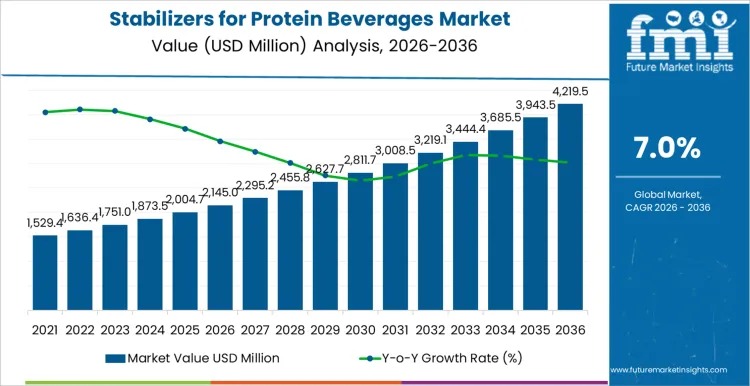
NEWARK, DE, UNITED STATES, January 19, 2026 /EINPresswire.com/ -- The global stabilizers for protein beverages market is forecast to grow from USD 2,145.0 million in 2026 to USD 4,219.5 million by 2036, registering a compound annual growth rate (CAGR) of 7.0%, according to the latest industry outlook. Growth reflects the increasing technical challenges associated with formulating high-protein liquid beverages that maintain physical stability, visual appearance, and acceptable mouthfeel throughout processing, storage, and distribution.
Stabilizers are increasingly central to the commercial viability of ready-to-drink (RTD) protein shakes, sports beverages, medical nutrition drinks, and fortified dairy and plant-based beverages. As manufacturers raise protein concentrations using whey, pea, soy, and blended protein systems, risks related to sedimentation, aggregation, and phase separation intensify directly affecting consumer acceptance and shelf performance.
Discover Growth Opportunities in the Market – Get Your Sample Report Now
https://www.futuremarketinsights.com/reports/sample/rep-gb-31464
Market Context: Why Stabilizers Matter in Protein Beverages
Protein beverages behave differently from conventional low-protein drinks. Proteins interact with water, minerals, and processing conditions in ways that can lead to instability under heat, shear, and pH variation. Shelf-stable distribution, exposure to temperature fluctuations, and extended storage cycles further elevate the importance of stabilizers that preserve drinkability without introducing slimy or chalky textures.
Beverage developers increasingly prioritize stabilizers that remain effective during UHT processing, high-shear mixing, mineral fortification, and sugar reduction strategies, while also aligning with clean-label objectives. Cost pressures favor multifunctional stabilizer systems capable of delivering suspension stability, viscosity control, and processing tolerance at low inclusion rates.
Quick Market Snapshot
• Market Value (2026): USD 2,145.0 million
• Forecast Value (2036): USD 4,219.5 million
• CAGR (2026–2036): 7.0%
• Leading Stabilizer Type: Hydrocolloids
• Fastest-Growing Countries: India, China, Brazil, USA, UK
• Key Companies: CP Kelco, Cargill, Ingredion, Tate & Lyle, DSM-Firmenich
Key Drivers Supporting Market Expansion
• Rising production of high-protein RTD beverages across nutrition, sports, and medical categories
• Increased use of plant-based proteins, which introduce variability in solubility and sedimentation behavior
• Demand for shelf-stable performance across long and temperature-sensitive distribution chains
• Reformulation linked to sugar reduction and clean-label positioning
• Competitive pressure to maintain consistent texture and appearance across geographies
Stabilizers function by adjusting hydration dynamics and forming networks that keep protein particles suspended under varying temperature and pH conditions. Ingredient specialists tailor molecular weight distribution and charge density to match specific protein sources and processing parameters, while sensory scientists validate mouthfeel and viscosity profiles to avoid negative texture perception.
Market Segmentation Highlights
By Stabilizer Type
• Hydrocolloids (41.0%) dominate due to broad functionality in suspension control and viscosity management.
• Emulsifiers (24.0%) support fat-protein interactions and reduce phase separation.
• Modified starches (18.0%) provide body enhancement with controlled processing costs.
• Protein-based stabilizers (11.0%) are used where label familiarity and protein synergy are prioritized.
By Beverage Type
• Dairy-based protein beverages: 36.0%
• Plant-based protein beverages: 34.0%
• Sports and active nutrition drinks: 20.0%
• Medical and clinical nutrition drinks: 10.0%
By End User
• Beverage manufacturers: 76.0%
• Contract beverage formulators: 14.0%
• Nutrition and medical food brands: 10.0%
Regional Outlook: Growth Anchored in Performance Needs
Global demand is shaped more by formulation performance requirements than by beverage volume growth alone.
• India (8.3% CAGR): Expansion of RTD nutrition and sports beverages, combined with warm climate distribution, drives reliance on hydrocolloids and emulsifying systems.
• China (8.0% CAGR): Industrial-scale production and UHT processing favor stabilizers that deliver consistent viscosity and appearance over long logistics cycles.
• Brazil (7.6% CAGR): Tropical conditions and sugar-reduction reformulation increase stability challenges in mass-market dairy and sports drinks.
• United States (6.2% CAGR): Growth is driven by portfolio reformulation, plant protein adoption, and clean-label expectations rather than new category launches.
• United Kingdom (5.9% CAGR): Demand centers on compliance-driven reformulation of dairy alternative and sports nutrition beverages.
Competitive Landscape: Focus on Reliability and Sensory Neutrality
Competition in the stabilizers for protein beverages market centers on suspension efficiency, processing tolerance, sensory impact control, and formulation support depth. Suppliers support adoption through application labs, pilot trials, and co-development with beverage manufacturers and contract formulators.
• CP Kelco leads with hydrocolloid systems engineered for protein suspension and texture control.
• Cargill integrates stabilizers within broader texture and formulation platforms.
• Ingredion supports clean-label and protein-fortified beverage applications through starch and texturizer solutions.
• Tate & Lyle focuses on stabilizers balancing viscosity and taste neutrality.
• DSM-Firmenich applies sensory science and formulation expertise to functional beverage systems.
Outlook
As high-protein beverages continue to expand across lifestyle and clinical nutrition categories, stabilizers will remain essential to ensuring shelf stability, sensory reliability, and scalable manufacturing. Market growth through 2036 reflects not only rising protein inclusion, but the increasing technical sophistication required to deliver consistent, consumer-acceptable protein beverages at global scale.
Why FMI: https://www.futuremarketinsights.com/why-fmi
Related Reports Insights from Future Market Insights (FMI)
Food Certification Market https://www.futuremarketinsights.com/reports/food-certification-market
Better for You Snacks Market https://www.futuremarketinsights.com/reports/better-for-you-snacks-market
Dehydrated Onions Market https://www.futuremarketinsights.com/reports/dehydrated-onions-market
Mezcal Market https://www.futuremarketinsights.com/reports/mezcal-market
About Future Market Insights (FMI)
Future Market Insights, Inc. (FMI) is an ESOMAR-certified, ISO 9001:2015 market research and consulting organization, trusted by Fortune 500 clients and global enterprises. With operations in the U.S., UK, India, and Dubai, FMI provides data-backed insights and strategic intelligence across 30+ industries and 1200 markets worldwide.
Sudip Saha
Future Market Insights Inc.
+1 347-918-3531
email us here
Legal Disclaimer:
EIN Presswire provides this news content "as is" without warranty of any kind. We do not accept any responsibility or liability for the accuracy, content, images, videos, licenses, completeness, legality, or reliability of the information contained in this article. If you have any complaints or copyright issues related to this article, kindly contact the author above.
